Quick links
orange shirt
DCHP-3.1 (May 2026)
1an. — Indigenous, Reconciliation
an orange shirt taken from Phyllis Webstad at residential school in 1973.
Type: 4. Culturally Significant — Phyllis Webstad, a Northern Secwpemc woman from the Stswecem’c Xgat’tem First Nation and a residential school survivor, first shared the story of her orange shirt in April 2013 at the St. Joseph Mission Residential School Commemoration Project and Reunion event in Williams Lake, British Columbia (see Orange Shirt Society reference to hear her story).
In this context, orange shirt is Type 4-Culturally Significant, serving as both a reminder of the lasting impact of the residential school system and as the inspiration for Orange Shirt Day, a movement dedicated to promoting truth and reconciliation.
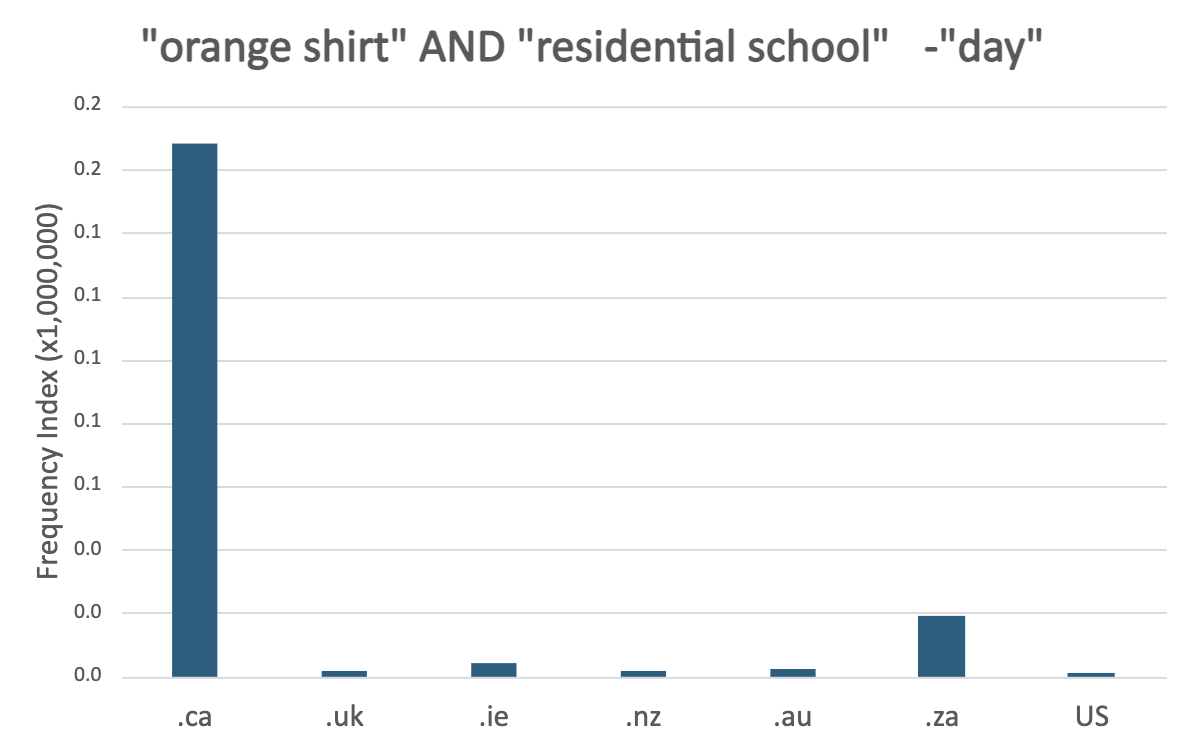
This term can also be considered a Type 5-Frequency Canadianism, as internet domain searches indicate that, when associated with residential schools, orange shirt is used almost exclusively in Canada (see Chart 1).
In this context, orange shirt is Type 4-Culturally Significant, serving as both a reminder of the lasting impact of the residential school system and as the inspiration for Orange Shirt Day, a movement dedicated to promoting truth and reconciliation.
This term can also be considered a Type 5-Frequency Canadianism, as internet domain searches indicate that, when associated with residential schools, orange shirt is used almost exclusively in Canada (see Chart 1).
Quotations
2013
The idea [of Orange Shirt Day] came after former St. Joseph's Mission Residential School student Phyllis Webstad told a story during a panel discussion on April 26 about her grandmother buying her a new shiny orange shirt for her first day of school. Upon arrival at school, the shirt and her other clothes were taken away, and replaced with a uniform."I couldn't wear orange for many years," Webstad said.
1bn. — Indigenous, Reconciliation
a commemorative orange shirt worn on Orange Shirt Day.
Type: 4. Culturally Significant — The generic term orange shirt refers to the orange shirts (often T-shirts) worn or displayed on Orange Shirt Day (see Image 1 for an example). Inspired by Webstad's story (see meaning 1a), this gesture conveys remembrance and a commitment to reconciliation, honouring residential school survivors, the children who never returned home, and their families and communities.
As with meaning 1a, this term is a Canadianism by virtue of cultural significance and frequency (see Chart 1).
As with meaning 1a, this term is a Canadianism by virtue of cultural significance and frequency (see Chart 1).
Quotations
2013
A sea of orange filled Boitanio Park as hundreds of people gathered in Williams Lake Monday morning to mark the first-ever Orange Shirt Day, honouring residential school survivors and those who did not survive. […] [National Chief Shawn A-in-chut] Atleo said around 50 people, wearing orange shirts with the slogan "Everyone [sic] Child Matters," had a photograph taken in front of the parliament buildings Monday morning.
2021
By wearing orange shirts, we are acknowledging the truth of the residential school system, and honour survivors, families and communities.
2n. — Indigenous, Reconciliation; in figurative use
a symbol of truth and reconciliation.
Type: 4. Culturally Significant — Rooted in Webstad's story (see meaning 1a), orange shirts have become a symbol of truth and reconciliation.
As with the previous meanings, this term is a Canadianism by virtue of cultural significance and frequency (see Chart 1).
As with the previous meanings, this term is a Canadianism by virtue of cultural significance and frequency (see Chart 1).
Quotations
2019
To prepare for her first day [at residential school], the young Webstad bought a special orange shirt, which would later become the inspiration for the national symbol for survivors of the residential school system. The symbol is perhaps a perfect analogy for the legacy of residential schools - that shirt, an expression of her identity and a product of her innocence, was taken away from her almost immediately after she arrived. In its stead, she was given the same generic clothing that all her peers were given, their individuality stripped away by the schools.
2021
"The orange shirt, which symbolizes loss and healing, renews awareness of the residential school history in a peaceful way."
2025
But what began as grassroots designs by Indigenous artists has now entered the mainstream. Orange shirts are widely available online and in major retailers. For some, this expansion is troubling. Stephen Jerome, a Mi'kmaw artist, says it feels like commercialization risks emptying the symbol of its meaning. "I see all these 'Every Child Matters' T-shirts and I'm like, 'What's an organization like this doing profiting off the death of our First Nations people?" he asked. May agrees. The artist said she tells people to buy directly from Indigenous artists or to wear a plain orange shirt rather than one from a chain store.
References
- Orange Shirt Society • Phyllis Webstad - On Orange Shirt Day (2021)
Images
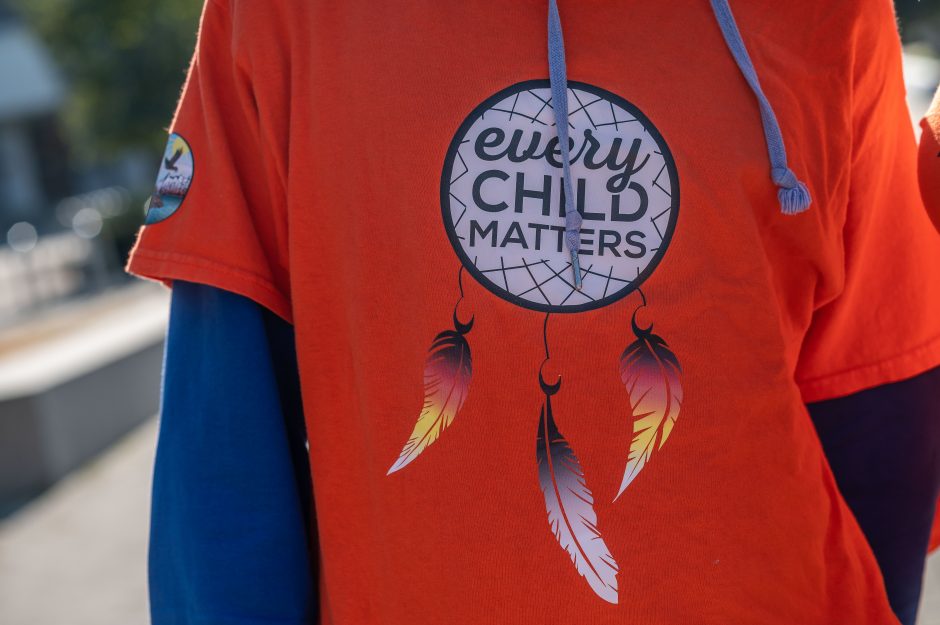
Image 1: Example of an orange shirt with the slogan "Every Child Matters", 30 September 2022. Source: Indian Residential School History and Dialogue Centre (https://irshdc.ubc.ca/orange-shirt-day-2022-photo-gallery/).